 Console Competition. Transitioning Screen Time to Range Time
How USPSA turns strategy, scoring, problem-solving and skill progression into a real-world competitive sport. Take the strategy, competition, and skill progression you love about gaming off the screen and into a real-world competitive sport.
What if you could step inside the game?
The strategy. The scoring. The problem-solving. The competition. The constant pursuit of a better score.
Competitive Shooting takes many of the things gamers already love and turns them into a real-world competitive sport.
Except now, you become the controller.
Navigate the stages, develop your live stage plan, and real physical skills of coordination, accuracy, movement and focus. As stages are constantly changing to keep you challenged-you are planning in real time as you walk the stage to identify the targets, determine where you plan to engage them, decide where movement and reloads best fit, and then try to execute your plan when the timer starts. Yesterday's score becomes today's competition.
Discover USPSA -
Discover the sport. Attend a match. Learn the rules. Meet the community. Decide whether it is for you.
The United States Practical Shooting Association, most commonly known as USPSA, is a competitive shooting sport built around courses of fire called stages.
Don't think of this as simply standing in one place and shooting at a paper target.
Depending on the unique stage plan, competitors move between shooting positions, engage multiple targets, work around obstacles, make decisions about the order in which to engage targets, reload, and balance speed while retaining accuracy.
Every stage presents a new problem to solve.
That's part of what makes the sport so appealing.
You aren't just competing against other shooters. You're constantly competing against your own previous performance.
Don't just find a hobby—make it work for you.
Get Creative with Content - Competitive shooting doesn't have to be only about competing. Create a team, create a community and create a channel.
Use the technology you already love to take your skills to the next level as a content creator. Put the technology you already love to work—build a channel, create technical content, develop your videography skills, and document your real-world progression one match at a time.
Share your first moments, share your insecurities, share your research and equipment choices, share what you learn, compare how you grow.
Create. Compete. Capture. Share. Practice. Repeat.
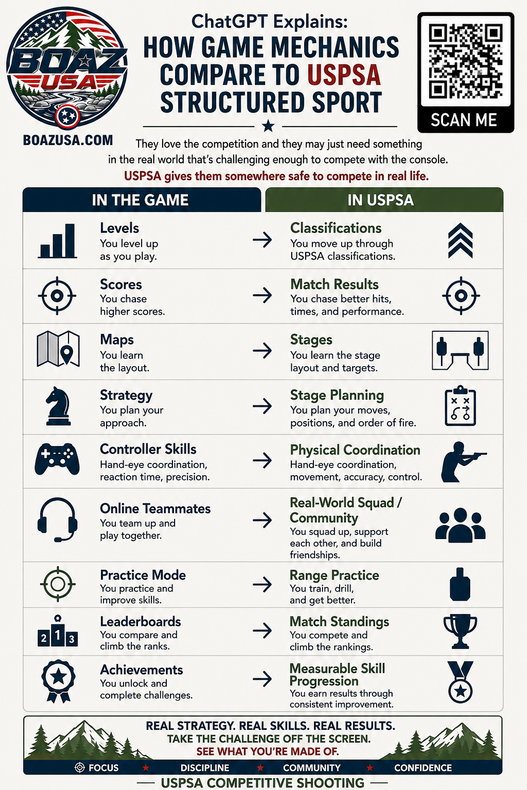
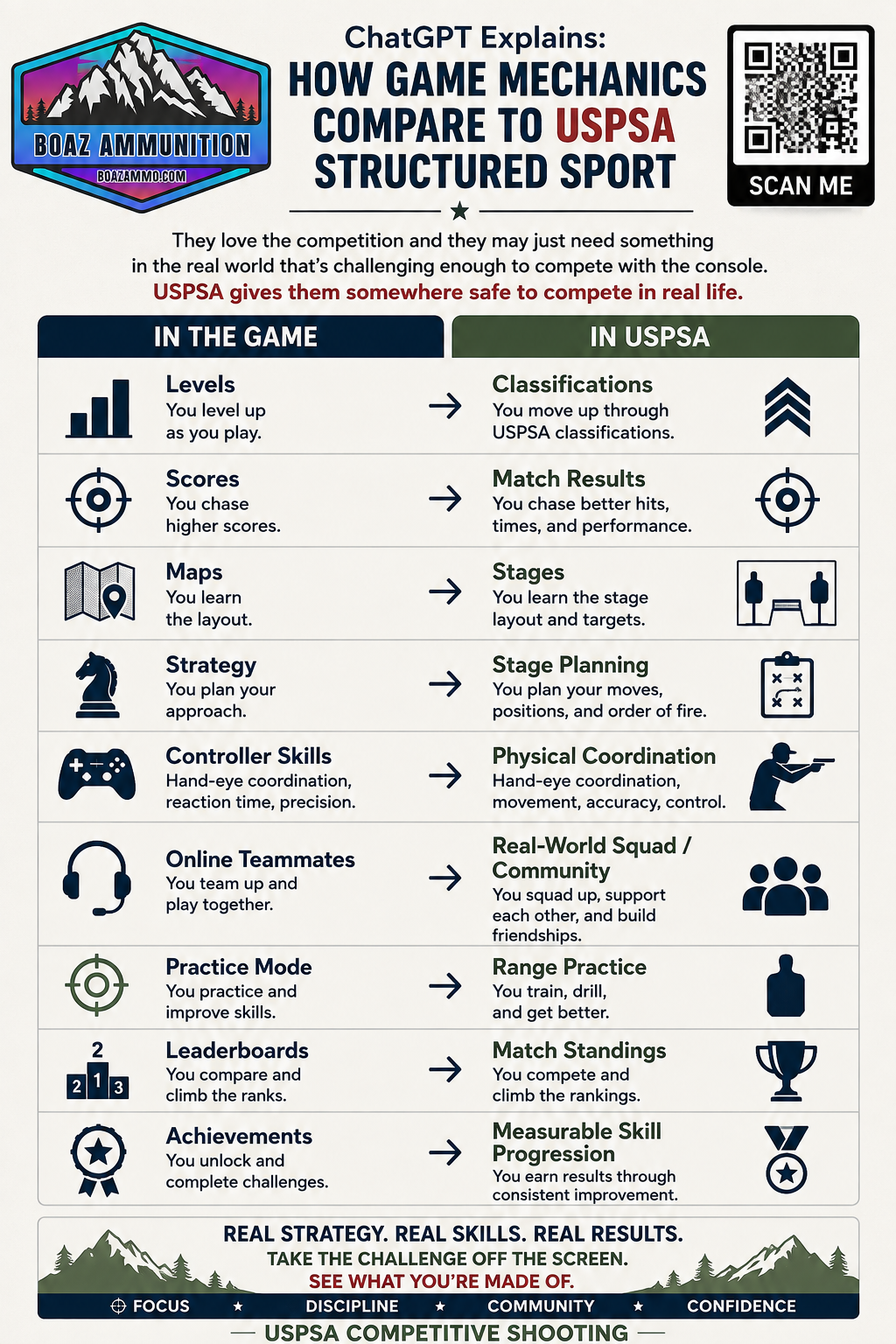
I ask ChatGPT to explain... how game mechanics compare to the USPSA competitive shooting characteristics. (Featured in the photo)
Levels → classifications
Scores → match results
Maps → stages
Strategy → stage planning
Controller skills → physical coordination
Online teammates → real-world squad/community
Practice mode → range practice
Leaderboards → match standings
Achievements → measurable skill progression
While this option may appeal to gamers who are growing older and looking for a more mature, real-world challenge, organized opportunities are also available for younger participants. Maybe the problem isn’t that they don’t like doing anything. Maybe they simply haven’t found something beyond the console that’s challenging enough to hold their attention. Structured sporting participation, with appropriate adult supervision and club requirements, can give them an environment where they can safely learn, develop skills, and compete in real life.
How The Matches Develop Community
You squad together.
You help reset stages.
You learn from each other.
You celebrate a great run—and occasionally laugh together when someone's perfectly planned stage goes completely differently than expected.
Eventually, the people can become as much a part of the hobby as the competition itself.
Taking the Challenge Off the Screen—but Is It Safe?
We routinely accept risk in everyday activities such as athletics or traveling in vehicles. The better question isn't whether an activity has zero risk, but how that risk is managed. USPSA manages the inherent risks of competitive shooting through a highly structured system of rules, Range Officers, range commands, and immediate enforcement of safety violations. USPSA is a shooting sport involving real firearms, so safety has to come before competition, speed, or score. Matches operate under formal safety rules, Range Officer supervision, designated safe handling procedures, and specific range commands.
For someone attending their first match, the objective isn't to see how fast they can go. It's to understand the rules, follow the Range Officer's commands, and learn how the sport operates safely before worrying about performance.
And safety doesn't stop when the timer does. The Range Officer directs the competitor through the process of finishing the course and safely clearing and securing the firearm before the range is declared clear.
For someone coming from gaming, think of the Range Officer as much more than a referee. The RO isn't simply watching your score—they are there to administer the course of fire and enforce the rules that allow competitors to enjoy the challenge within a controlled sporting environment.
That's an important distinction. The NROI Range Officer Creed places safety first and foremost. For example, a violation can result in a “Stop” command at any time, requiring the competitor to immediately cease firing, stop moving, and await instructions.
Real competition. Real responsibility. Real safety rules.
Ready Player One?
Range Officer: “Make Ready.”
Competitor prepares under the RO's supervision.Range Officer: “Are You Ready?”
No negative response means the competitor is ready.Range Officer: “Standby…”
BEEP!
Your next level starts here.
And when the stage is finished:
Range Officer: “If You Are Finished, Unload and Show Clear.”
Featured Spectator Locations
Check with the host club or match director before attending for current spectator policies, schedules, eye/ear protection requirements, and other range rules. That is one way to learn the flow and safety procedures.
I am going to be featuring several local options you can go to experience the community. Not from this area? Not a problem. Find your local USPSA Club or upcoming matches. Kettlefoot and TAC2 as the two close-to-home Tri-Cities choices, however, ORSA is a contendor that is absolutely "worth the drive" that gives you three rotating weekend options each month.
Where to Shoot USPSA Near Johnson City & the Tri-Cities?
Normally Scheduled Area USPSA Rotation
First Saturdays - TAC2 Gun Club
Third Saturdays - ORSA Practical Shooters
Fourth Saturdays - Kettlefoot Rod & Gun Club